
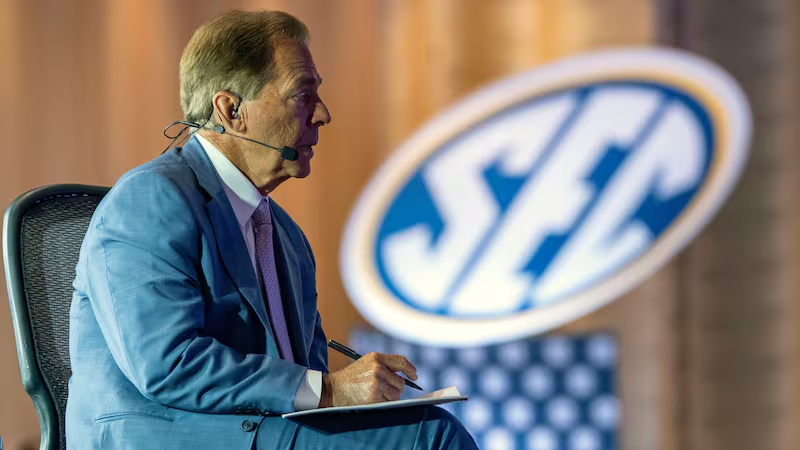
By now, the college sports world has lived with radical change. The transfer portal has turned rosters over like a revolving door, and Name, Image, and Likeness (NIL) money has rewritten recruiting and player priorities. Yet while administrators scramble, one voice has consistently offered clarity, common sense, and a real plan for reform: Nick Saban. If the NCAA genuinely wants to evolve into a coherent, athlete-centered, and competitively balanced system, there is arguably no one better equipped than the legendary coach to lead that charge as a Commissioner not just of college football, but of all NCAA athletics.
What Saban Understands That Others Don’t
Saban’s coaching legacy is undisputed, but it is his philosophical and structural insight into how college sports should work that makes his potential leadership vital. Far beyond game strategy, Saban has repeatedly critiqued the ecosystem itself. He sees the current transfer portal as chaos, not opportunity, a free-agency machine that undermines commitment and team culture. He has called for realignment of the college calendar and portal windows to reduce disruption and mimic the order of professional leagues.
Saban emphasizes balance between benefits and obligations, arguing that if athletes receive scholarships and NIL opportunities, there should still be a shared sense of contractual responsibility to their teams and institutions. He has spoken publicly about the need to fix unintended consequences of NIL. He is not opposed to player compensation, but warns against unlimited bidding wars and inequitable systems where money becomes the primary factor over development and education. What is critical is not simply critique, it is proposed solutions grounded in long-term stability rather than short-term advantage.
A Blueprint for the Transfer Portal
The transfer portal was born out of fairness, a mechanism for athletes to have mobility. But today it often functions without structure or consequence. Saban’s strategic vision addresses both the spirit and structure of the portal.
Aligning portals with academic and team schedules. Saban has suggested moving the portal to align with academic calendars, ideally opening in May after spring practice, so that teams can finish seasons intact and prepare together in summer. This reduces mid-season disruptions and chaotic roster turnover.
Encouraging meaningful commitment. In earlier eras, transferring required sitting out a year, a rule Saban has defended as a form of stability that benefited player development and competitive balance. He believes some equivalent framework should exist to prevent impulsive exits that weaken teams and players’ own growth.
Protecting roster continuity and competitive integrity. Unlike today’s unbounded movement, Saban wants structures that protect both players and programs. In his words, no one should be able to opt out, transfer, and do whatever they want whenever they want. A Commissioner with Saban’s portal vision could bring order, fairness, and predictability to a system that currently feels like organized chaos.
Reining in NIL Without Reversing Player Rights
Saban has been clear that he supports student-athletes earning money because they should, but he also warns that a free-for-all NIL market has shifted focus away from development toward dollar signs.
Uniform standards are essential. Having multiple state laws and no federal regulation creates litigation and unequal competitive landscapes. Unfettered collectives misrepresent the original intent of NIL. Players deserve agency, but not a pay-to-play bidding war. Balance matters. Reward systems should reflect effort, commitment, and development, not just the size of a financial offer. As Commissioner, Saban would bring structure to NIL regulations, bolstering fairness without stripping players of opportunity, and coordinating with lawmakers when necessary. His involvement in legislative discussions shows he understands both the sports and policy sides of reform.
Why Saban’s Leadership Is Not Just Good, It Is Necessary
The NCAA today has no central figure who can speak with authority across all sports on the most pressing structural issues. Football, basketball, and Olympic sports face diluted team identity due to player churn, financial arms races that favor wealthier programs, and inconsistent governance that incentivizes litigation over stability. Saban has not only identified these problems, he has been proposing solutions. He has called for a commissioner and competition committee to define uniform rules across programs. He has advocated for federal involvement to create enforceable NIL standards and structural alignment of competition, academics, and athlete mobility periods. That combination of strategic vision, deep respect for athletes’ rights, and focus on stability would give the NCAA something it desperately lacks: coherent governance that matches the scale of modern college sports.
The Bottom Line: Saban for Commissioner
Nick Saban’s leadership, forged through decades of building championship-level programs, extends far beyond playbooks and recruiting boards. In an era where college sports confront seismic shifts in player autonomy, commercial influence, and institutional accountability, Saban brings a strategic mindset for systemic reform, a focus on balance between athlete rights and program stability, and a vision that champions both competitive fairness and player development.
If the NCAA truly wants to thrive in the transfer portal and NIL era, it needs leaders who can structure chaos into sustainable systems. That is exactly what Nick Saban has been talking about for years. Not coach, not advisor, Commissioner. The sport would be better for it.



Leave a Reply